
Contents
The Anatomy of a Historic Victory
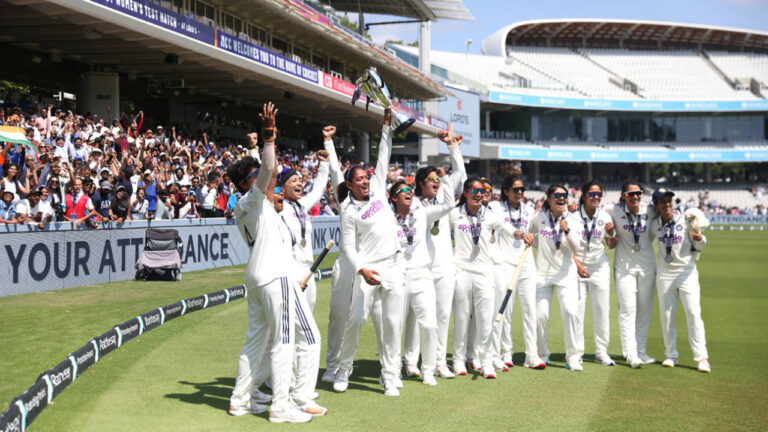
When Sneh Rana delivered a masterclass of off-spin to bowl Sophie Ecclestone, she did more than just secure a wicket; she punctuated a dominant 270-run victory for India at the spiritual home of cricket. While the result was labeled by many as a monumental upset, a closer analysis of the team’s preparation and structural support confirms that Why India’s Lord’s Test win is not a surprise lies in the deliberate efforts made by the BCCI to foster red-ball talent.
The Advantage of Preparation
Cricket is a game of fine margins, and preparation often dictates the outcome in the Test arena. While England faced a condensed schedule, struggling to transition from the intensity of the T20 World Cup final to the patience required for a red-ball match, India was better positioned. The Indian squad utilized the time following their T20 World Cup exit to conduct specialized training sessions at the Wormsley Cricket Club. This acclimatization to the English conditions and the specific demands of the Dukes ball provided a tactical edge that was evident from the first ball of the match.
The Role of Domestic Red-Ball Cricket
Perhaps the most significant factor in India’s success is the existence of the Senior Women’s Inter-Zonal Multi-Day Trophy. After the discontinuation of multi-day tournaments in 2017-18, the return of a domestic red-ball structure in 2023-24 has been transformative. It is not a coincidence that twelve members of the Indian squad, including those who arrived as replacements, had recent exposure to multi-day cricket.
- Skill Repetition: Players like Yastika Bhatia—who became the first woman to score a Test century at Lord’s—entered the match with thirteen first-class appearances.
- Depth of Experience: Smriti Mandhana, a pillar of the batting lineup, brought the stability of fifteen first-class matches into the contest.
- The Feeder System: By ensuring that players are accustomed to the mental and physical rigors of long-format cricket, the BCCI has created a pipeline that is the envy of the cricketing world.
Comparing Global Infrastructure
England’s stalwart Heather Knight, who concluded her international career following this match, acknowledged the disparity in domestic systems. Despite her own wealth of experience, Knight highlighted that England’s younger generation is increasingly skewed toward T20 and 50-over formats. Without a consistent domestic red-ball structure, the learning curve for England’s players in the Test arena remains significantly steeper. Currently, India stands as one of the few nations—alongside Australia, with its limited one-off fixtures—to prioritize a dedicated domestic red-ball pathway for women.
Tactical Execution on the Field
The match was characterized by India’s ability to read the game and repeat successful processes under pressure. Unlike teams that treat a Test match as an extension of a limited-overs game, India demonstrated the capacity to build an innings and shape spells with disciplined bowling. This maturity in approach is a direct byproduct of the domestic multi-day format, which emphasizes valuing the wicket and sustaining concentration over long periods.
A Legacy of Consistency
Statistically, India’s dominance over England in the red-ball format is not a recent phenomenon. Their record in England remains unblemished, with their last defeat occurring back in 1995. By consistently winning and developing a core of red-ball specialists, India has ensured that their success is not a flash in the pan but a reflection of a robust cricketing ecosystem. As the women’s game continues to evolve, India’s foresight in maintaining a domestic red-ball circuit will likely serve as the benchmark for other nations looking to bridge the gap in international Test cricket.
Ultimately, the victory at Lord’s serves as a powerful reminder that in cricket, success is rarely accidental. It is the result of planning, structure, and the foresight to invest in the fundamentals of the sport. While the historic venue added a layer of prestige to the win, the victory was crafted in the training camps and domestic grounds of India, proving that their rise in the longest format is both earned and inevitable.