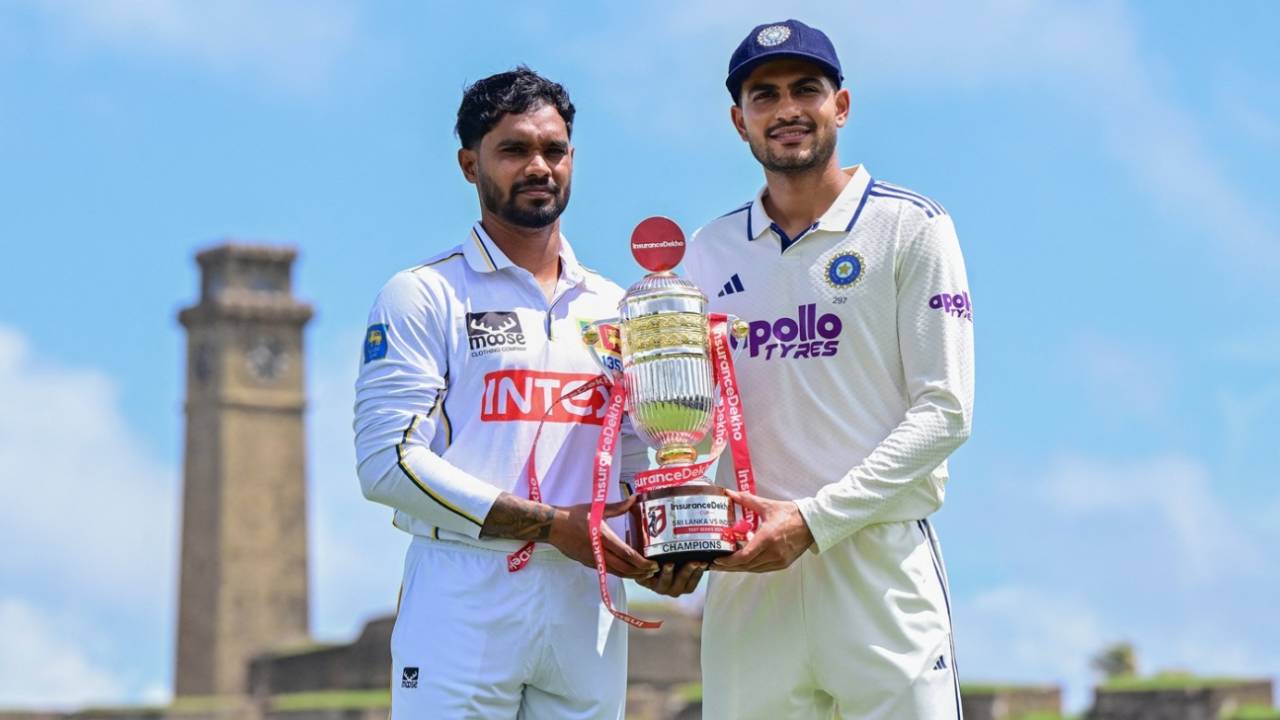
Anticipating the Clash: India and Sri Lanka Meet in a Vastly Different Test Landscape
Contents
The Big Picture: India’s 600th Test and Galle’s 50th Milestone
Six years have passed since India last toured Sri Lanka for a Test series, a period that saw them dominate the island nation during what was widely considered a golden era for Indian cricket. That 2017 tour resulted in a resounding victory for the visitors, leaving the hosts struggling to compete. However, the cricketing landscape has undergone significant shifts since then. Not only has the global Test calendar evolved, but the frequency and length of Test series between these two nations, traditionally known for their captivating encounters in Sri Lanka, have also diminished. This upcoming series is therefore steeped in a different context, far removed from the one-sided affairs of the past.
In 2017, the Indian team found the Sri Lankan pitches almost a second home, offering the consistent bounce and turn that allowed their formidable spin attack to flourish and ultimately outshine the local bowlers, even with the legendary Rangana Herath in their ranks. While India has since demonstrated immense prowess at home, their recent losses in two of their last three home series mean they do not enter this contest as the overwhelming favourites they once were, despite their impeccable record of winning their last five Tests in Sri Lanka.
Both teams find themselves in periods of significant transition. India, though still a formidable unit, is navigating changes in its Test squad, particularly in the bowling department following the retirement of R Ashwin and the unavailability of key pacers like Mohammed Shami and Jasprit Bumrah. Sri Lanka, on the other hand, appears to be in something of a Test exile, having played only two Tests in the last 13 months, a stark contrast to India’s one Test this year which is considered an aberration. The scarcity of longer Test series for Sri Lanka over the past eight years—only two exceeding two matches—makes it particularly challenging to gauge their current form and collective strength.
As such, expectations for this series are tinged with uncertainty. Sri Lanka will undoubtedly be desperate to field a spin attack capable of posing genuine threats from both ends, while India will be equally keen to rebound from their recent series defeats against South Africa and New Zealand, both of which occurred in conditions that typically favour spin. Sri Lanka’s most promising path to victory likely hinges on winning the toss and capitalizing on the early conditions to put a substantial total on the board before the pitch increasingly assists the spinners, as is often the case in Sri Lanka. In the absence of Pathum Nissanka, the onus will be on Dhananjaya de Silva, Kamindu Mendis, and Dinesh Chandimal to anchor the batting. India’s batsmen, meanwhile, will need to adapt swiftly to the local conditions, aiming to avoid being caught off guard in the opening Test.
Amidst these challenges and transitions, certain milestones are guaranteed. India will proudly become only the third nation in Test cricket history to have played 600 Tests when they step onto the field in Galle. Coincidentally, Galle itself will create history by becoming the first Asian ground to host 50 Test matches, adding a layer of historical significance to an already anticipated encounter.
Current Form Guide
Examining the recent performance of both teams provides some insight into their current standing:
- Sri Lanka: D-L-W-D-L (most recent result first in their last five completed matches) – This mixed bag of results indicates inconsistency, with a recent draw and loss suggesting areas for improvement.
- India: W-L-L-W-W (most recent result first) – India’s form, despite the recent losses, shows a resilient streak, especially with two recent wins. The defeats highlight areas of concern that the team will be eager to address.
In the Spotlight: Ravindra Jadeja and Prabath Jayasuriya
Ravindra Jadeja: India’s New Spin Maestro
Ravindra Jadeja stands out as one of only two players in the current Indian squad with prior Test experience in Sri Lanka, making his role even more crucial. With the seasoned R Ashwin having retired, and Mohammed Shami deemed not fit enough for Tests, alongside Jasprit Bumrah’s injury-forced absence, Jadeja now assumes the mantle of the primary attacking spinner and a vital leader in the bowling unit. This elevated status brings a different kind of spotlight for Jadeja, who has typically preferred a quieter, consistent approach to his bowling, wheeling in over after over with relentless accuracy. At 37 years old, and carefully managed in shorter formats to preserve his Test career, Jadeja is tasked with setting the tone for India’s attack in Sri Lanka, a responsibility that demands both experience and sustained performance.
Prabath Jayasuriya: Sri Lanka’s Wicket-Taking Hope
For Sri Lanka, Prabath Jayasuriya is an indispensable asset whose form could well dictate the outcome of the series. It is difficult to envision Sri Lanka securing a Test victory, let alone the series, without Jayasuriya, their leading wicket-taker of the current decade, performing at his absolute peak. His record in home Tests is impressive, boasting 11 five-wicket hauls and two ten-wicket hauls in just 14 matches. However, his average of 27.26, while acceptable, suggests there is room for improvement in his efficiency. Jayasuriya has consistently taken the bulk of the wickets for Sri Lanka, but the challenge now is to do so more quickly and decisively, putting greater pressure on the opposition’s batting lineup.
Team News: Key Returns and Strategic Selections
Sri Lanka’s Tactical Recalls
Niroshan Dickwella, whose last of 54 Tests was played in 2023, has been recalled to the Sri Lankan squad. This decision highlights a strategic preference for experience over the recent domestic performances of younger wicketkeeper-batsmen. Sri Lanka is expected to adopt a traditional approach, featuring two seamers and three spinners, with Sonal Dinusha providing crucial batting depth down the order. The probable XI reflects this balanced strategy:
- 1 Lahiru Igalagamage
- 2 Nishan Fernando
- 3 Dinesh Chandimal
- 4 Kamindu Mendis
- 5 Dhananjaya de Silva (capt.)
- 6 Niroshan Dickwella (wk)
- 7 Sonal Dinusha
- 8 Prabath Jayasuriya
- 9 Ramesh Mendis
- 10 Asitha Fernando
- 11 Lahiru Kumara
India’s Opportunity for Kuldeep Yadav
For India, the inclusion of Kuldeep Yadav in the probable XI is less a comeback and more an opportunity presented by the specific combination and conditions that favour his wrist-spin. After a prolonged period on the bench across formats, Kuldeep has much to prove. India, too, is likely to deploy two seamers alongside their three left-arm spinners, aiming for variety and depth in their attack. Devdutt Padikkal is expected to step in for the injured B Sai Sudharsan, while Dhruv Jurel is anticipated to play as a specialist batter, bolstering the middle order. India’s probable XI is:
- 1 KL Rahul
- 2 Yashasvi Jaiswal
- 3 Devdutt Padikkal
- 4 Shubman Gill (capt.)
- 5 Rishabh Pant (wk)
- 6 Dhruv Jurel
- 7 Ravindra Jadeja
- 8 Manav Suthar
- 9 Kuldeep Yadav
- 10 Mohammed Siraj
- 11 Prasidh Krishna
Pitch and Conditions: An Unexpected Surface in Galle
Contrary to the typical expectations of a dustbowl turner in Galle, Sri Lanka’s captain Dhananjaya de Silva has indicated that this pitch will offer a different challenge. This unexpected characteristic could be a tactical decision, or it might be influenced by the prevailing weather conditions, which have reportedly hampered pitch preparation and resulted in more moisture than is usually found. Despite this, the consensus remains that batting first will be advantageous, allowing teams to navigate the initial movement for seamers and then capitalize on the best batting conditions as the pitch wears.