Confident West Indies look to sweep nervy Pakistan 2-0 in Second Test


Contents
The Big Picture: West Indies Eye Historic Series Win
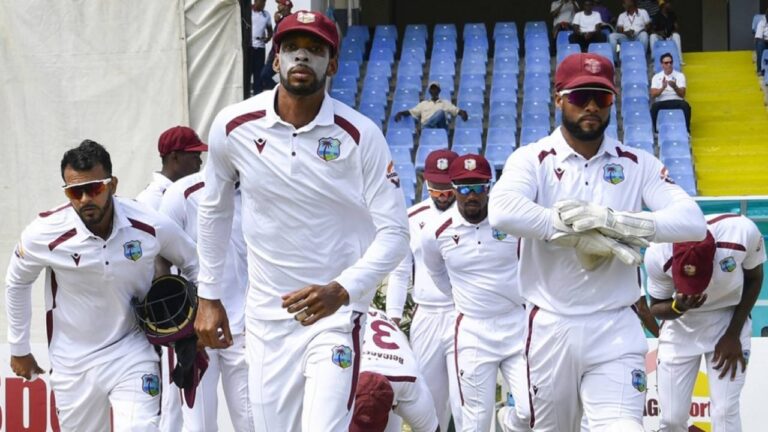
The recent Test encounter in Tarouba offered clear insights into the current state of both the West Indies and Pakistan Test teams. While both sides occupy similar rankings in the global Test arena, their recent performances have highlighted distinct strengths and weaknesses. West Indies effectively leveraged their dynamic pace attack and the significant boost in confidence gained from their recent home series triumph against Sri Lanka. This contrasted sharply with a Pakistan outfit that appeared devoid of genuine pace and, critically, confidence in the longer format of the game. Now, with a commanding 90-run victory already under their belt, the West Indies are poised to clinch the series in Port-of-Spain, a venue traditionally more accustomed to Test cricket.
The hosts find themselves in a remarkably promising position in Test cricket, a sentiment not often echoed in recent years. It has been over four years since the West Indies last enjoyed a streak of three successive Tests without defeat, underscoring the significance of their current momentum. Their pace attack, a blend of seasoned experience and youthful dynamism, is complemented by effective spin options, creating a well-rounded bowling unit. While batting remains a discernible vulnerability, against teams like Pakistan, who have shown a susceptibility to quality seam bowling, West Indies possess the arsenal to outgun them. Their approach in the series against Sri Lanka and the first Test against Pakistan demonstrated a newfound patience to build strong positions and a tenacious fight to recover when falling behind.
For West Indies, the primary challenge now lies in maintaining this newfound consistency. After a performance where they sustained their high level for the better part of four days, the focus must be on preventing any lapse. Though their batters may not possess the same elite class as their bowlers, they demonstrated admirable resilience in challenging conditions, providing just enough runs for their formidable pace attack to work with. Crucially, West Indies refused to let the game slip away when Pakistan appeared to be gaining dominance, cleverly staying within contention and timing their decisive strikes to perfection. They undoubtedly hold a significant mental edge over the visitors, and if they can uphold their current standards, another successful outing appears highly probable.
In stark contrast, the outlook for Pakistan appears considerably bleaker. Their almost habitual tendency to falter under pressure, even against evenly matched opponents or from advantageous in-game situations, has become a concerning pattern. It was not long ago in the first Test that Pakistan were just 67 runs adrift of West Indies’ first-innings total with seven wickets still in hand. A team with greater belief and composure would have seized this opportunity to build a substantial lead. However, Pakistan, whose lower-order fragility and vulnerability in the third and fourth innings have become almost epidemic, proceeded to lose their subsequent 16 wickets for a mere 109 runs. This collapse highlights deep-seated issues that need urgent addressing.
Despite these recent struggles, it is important to acknowledge that, on paper, the two sides possess relatively comparable quality. The absence of Shan Masood due to injury is a blow, but it remains true that all but one of Pakistan’s top seven batters boast superior Test batting averages compared to their West Indies counterparts. In Babar Azam, Pakistan possesses a batter of a pedigree simply unmatched within the current West Indies line-up, even with his recent concerns over a dip in form. Had Pakistan not endured such a dismal run in Test cricket recently, the batting strengths of both teams would likely be discussed as a clear point of differentiation in Pakistan’s favor.
Furthermore, Mohammad Abbas’s relative lack of express pace has not hindered his ability to deliver elite numbers in Test cricket, nor did it prevent him from making inroads against the West Indies in the first Test. While his bowling compatriots may not operate in the same league, Mohammad Ali and Khurram Shahzad still enjoyed periods of dominance against a modest West Indies batting line-up. Ultimately, this second Test pits two inherently flawed sides against each other. However, one has clearly demonstrated the capacity to overcome its imperfections and secure victory, while the other, for three long years away from home, has failed to taste that winning feeling. Pakistan certainly has the potential to alter this narrative, but as the first Test unequivocally showed, West Indies are exceptionally well-equipped to thwart their ambitions.
Form Guide
- West Indies: WDWLL (most recent first)
- Pakistan: LLLLW (most recent first)
In the Spotlight: Chanderpaul’s Grit and Shafique’s Opportunity
Tagenarine Chanderpaul: The Unyielding Opener
While scores of 21 and 35 might not immediately scream “match-winning performances,” Tagenarine Chanderpaul’s contributions in the bowler-dominated Test at the Brian Lara Cricket Academy were invaluable. True to his cricketing lineage, Chanderpaul displayed immense resolve and tenacity. In both innings, he steadfastly refused to surrender his wicket during sessions where Pakistan’s bowlers held sway, expertly seeing off the new ball on the first morning and battling resolutely when West Indies found themselves precariously placed at 43 for 4 in their crucial third innings. His efforts not only contributed 56 handy runs but also saw him face an impressive 178 deliveries – just 21 fewer than the most faced by any batter in that Test. This endurance effectively wore down the Pakistan attack and allowed his side the crucial breathing room needed to shift the momentum. In a series where bowling prowess on both sides clearly outweighs batting ability, Pakistan conspicuously lacks this kind of steel at the top of their order, and as the first Test clearly demonstrated, such resilience can indeed make a significant difference to the overall outcome.
Abdullah Shafique: A Chance for Redemption
Abdullah Shafique has endured a challenging period in international cricket for the better part of three years. After a whirlwind start to his Test career, his form has noticeably tailed off since the end of 2022, leading to a drop in the national team’s pecking order. His last 31 innings have yielded a modest 754 runs at an average of 25.13. However, even within this rough patch, Shafique has occasionally demonstrated the ability to chip in with valuable, albeit inconsistent, contributions. He notably scored a century against England in Multan in 2024 and a half-century in Rawalpindi against a tricky South African attack last year. With Shan Masood now ruled out due to injury, a crucial top-order slot has opened up, and Shafique has been handed a golden opportunity to reclaim his place and prove his worth at the highest level.
Team News and Potential Line-ups
West Indies: Stability Expected
Despite the desire for greater consistency from their batting line-up, the overall team combination for West Indies performed effectively enough in the first Test to make wholesale changes unlikely. The synergy between their bowlers and the resilience shown by some batters proved sufficient for victory.
West Indies (possible XI): 1 Tagenarine Chanderpaul, 2 Brandon King, 3 Kavem Hodge, 4 Shai Hope (wk), 5 Amir Jangoo, 6 Justin Greaves, 7 Roston Chase (capt), 8 Jomel Warrican, 9 Shamar Joseph, 10 Kemar Roach, 11 Jayden Seales
Pakistan: Deep Questions and Crucial Decisions
Pakistan, conversely, faces more profound questions and crucial decisions ahead of the second Test. Shan Masood’s unfortunate fractured finger rules him out, with Abdullah Shafique confirmed as his replacement. The team also needs to address an unbalanced middle order, highlighted by Aamer Jamal batting at No. 7 in the first innings and then at No. 6 in the second after Masood’s injury. With Saud Shakeel now added to the squad, a more natural position for Jamal would be at No. 8. However, this adjustment would necessitate reducing a bowler to accommodate an additional batter, potentially weakening the very aspect of their game that showed some promise in the first Test. Given their one-dimensional pace attack in the previous match, Pakistan retains the option of handing express quick bowler Ubaid Shah a Test debut to add variety. Furthermore, Ali Usman had a virtually anonymous debut, making a straight swap with Sajid Khan, who is waiting in the wings, a probable consideration.
Pakistan (possible XI): 1 Azan Awais, 2 Imam-ul-Haq, 3 Abdullah Shafique, 4 Babar Azam (capt), 5 Saud Shakeel, 6 Mohammad Rizwan (wk), 7 Salman Agha, 8 Aamer Jamal, 9 Sajid Khan, 10 Mohammad Ali/Khurram Shahzad/Ubaid Shah, 11 Mohammad Abbas
Pitch and Conditions: A Shift to Spin
While the Caribbean is currently in the midst of its wet season, an unusually dry spell is forecast to coincide with the second Test, suggesting minimal, if any, interruptions due to weather. The match will be played at the iconic Queen’s Park Oval, the traditional Test venue in Trinidad. This ground is historically known to offer more assistance to spin bowlers than the Brian Lara Cricket Academy did, meaning the spinners on both sides are likely to play a more significant role in the outcome of this decisive encounter.
Stats and Trivia
- West Indies have a chance to win their first Test series against Pakistan since 2000, marking a potentially historic achievement.
- Of Pakistan’s eight Test wins in the West Indies, their two most commanding triumphs both occurred at Queen’s Park Oval, the venue for the second Test. These victories, however, date back some time, representing Pakistan’s first two wins in the Caribbean: an innings and one run victory in 1958, and a 266-run win in 1977.
- If West Indies manage to avoid defeat in this Test, they will have secured consecutive Test series victories. The last time they achieved two successive Test series wins, with neither triumph coming against Zimbabwe or Bangladesh, was nearly three decades ago, when they defeated India and Sri Lanka back-to-back in 1997.