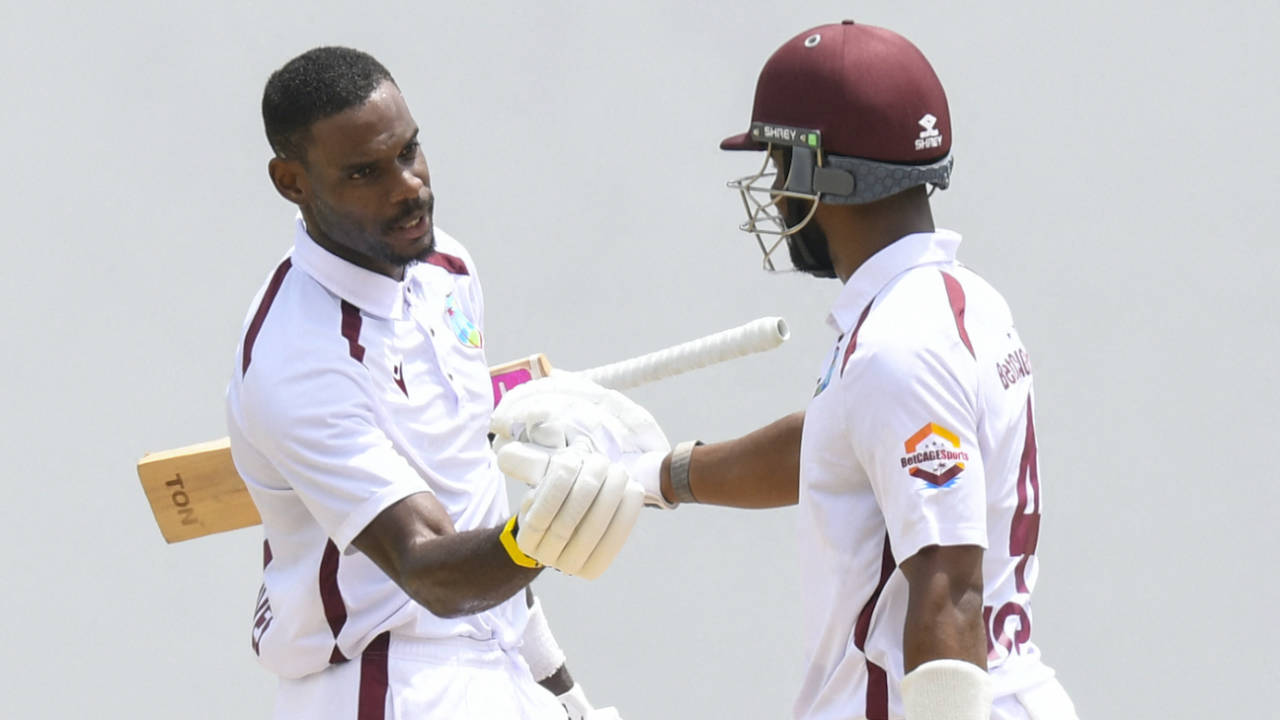
The fourth day of the Test match between West Indies and Sri Lanka unfolded with a compelling narrative of resilience and strategic batting. Responding to Sri Lanka’s formidable first innings total of 549 for 9 declared, West Indies reached 318 for 4 by lunch, significantly narrowing the deficit to 143 runs. This impressive fightback was orchestrated by a magnificent double-century partnership between Shai Hope and Justin Greaves, whose individual hundreds provided the backbone of the West Indies’ innings.
While the morning session saw the West Indies largely dominate, particularly through the unwavering focus of Hope and Greaves, it concluded with a late twist. Shai Hope, after a resolute innings, was dismissed just 15 minutes before the lunch break in an unusual fashion. His departure, though a minor setback, did little to dampen the spirits in the West Indies camp, who walked off the field undoubtedly the happier of the two sides. Roston Chase joined a well-set Justin Greaves in the middle, ready to continue the fight in the post-lunch session.
Contents
The Unconventional End to a Monumental Partnership
The marathon partnership between Shai Hope and Justin Greaves, which stretched to a formidable 242 runs off 459 deliveries, proved to be the bedrock of the West Indies’ resistance. This monumental stand not only stabilised the innings but also significantly eroded Sri Lanka’s burgeoning hopes of securing a series-levelling victory. Its conclusion, however, was as unconventional as it was pivotal.
Hope’s dismissal, for a well-made 112 off 243 balls, arrived not through a moment of brilliance from the Sri Lankan bowlers, but rather through a bizarre sequence of events. Facing an innocuous delivery from Sonal Dinusha, pitched on a leg-stump line, Hope attempted to pad it away. As the ball passed him and headed towards wicketkeeper Kusal Mendis, Hope, perhaps instinctively, dragged his back foot marginally out of the crease. In a stroke of unfortunate timing for the batsman, the ball deflected off Kusal Mendis’s gloves and then rolled back onto the stumps, dislodging the bails. The accidental nature of the dismissal provided a moment of relief for Sri Lanka, albeit one tinged with frustration that they hadn’t found a more conventional way to break the partnership earlier.
Early Morning Drama and a Crucial Let-Off
The morning session had begun with immediate drama. On just the second delivery of the day, with Shai Hope still on his overnight score of 86, fast bowler Milan Rathnayake found Hope tickling a delivery down the leg side. Wicketkeeper Kusal Mendis and Rathnayake himself appealed vociferously, convinced they had their man caught behind. However, umpire Paul Reiffel remained unmoved, his judgment firm.
Sri Lankan captain Dhananjaya de Silva faced a critical decision. Having already expended two of their three allotted reviews on the previous day, caution seemingly prevailed. De Silva opted not to review, a choice that, in hindsight, proved incredibly costly. Replays later indicated that Hope had indeed made contact, confirming a significant let-off for both the batsman and the West Indies. This missed opportunity was a bitter pill for Sri Lanka, who desperately craved an early breakthrough to assert their dominance and push for a series-levelling victory. Instead, Hope was granted a reprieve, setting the stage for his eventual century.
A Masterclass in Partnership Batting
Following Hope’s early escape, the morning session transformed into a masterclass in partnership batting, dominated entirely by the unwavering concentration and skill of Shai Hope and Justin Greaves. For hours, they dictated terms, absorbing pressure and dispatching anything loose with consummate ease. The Sri Lankan bowlers toiled diligently, but found little to trouble the well-set pair.
The only minor concern for the batsmen emerged from the pitch itself, as an increasing number of deliveries started keeping low off a good length. While this indicated a potential change in the surface characteristics as the match progressed, it was not yet persistent enough to genuinely threaten the batsmen or cause any significant alarm. Hope and Greaves continued to move in lockstep, their understanding and communication evident in every run they took and every ball they left.
The West Indies’ strategy was clear: bat for time, wear down the bowlers, and steadily chip away at the imposing target. The scoring rate was secondary to occupying the crease, and both batsmen executed this plan flawlessly, playing each ball on its merits. This patient approach meant boundaries were a rare sight, with only five registered throughout the session. Three of these came from the blade of Justin Greaves, who impressed with his elegant strokeplay, including a pair of textbook drives and a well-timed whip through midwicket, showcasing his serious batting chops and growing maturity at the Test level.
Milestone Centuries and Growing Reputations
The individual milestones reached by both batsmen were equally significant, underscoring their contributions to the West Indies’ fightback. Shai Hope was the first to reach his century, a diligently crafted innings achieved off 199 deliveries. This marked his fifth Test century, a testament to his class and resilience. Notably, it was his first Test hundred scored on home Caribbean soil, a moment of particular satisfaction for the Barbadian batsman.
Not long after, just four overs later, Justin Greaves brought up his own magnificent century, reaching the three-figure mark off 201 balls. For Greaves, this was his second century at the Sir Vivian Richards Stadium, a venue where he seems to thrive, and his third overall in Test cricket. His innings further solidified his growing reputation as a reliable middle-order batsman capable of sustained periods at the crease. This century also highlighted a crucial development in his career: his increasing ability to convert promising starts into substantial scores, with his Test centuries now outnumbering his Test fifties by a ratio of three to one, demonstrating a significant improvement in his conversion rate and temperament at the highest level of the game.
As the teams headed for lunch, the scoreboard read 318 for 4, a testament to the fighting spirit of the West Indies. While Sri Lanka managed to snatch a late wicket, the morning session belonged unequivocally to the home side, whose resolute batting, particularly the monumental stand between Greaves and Hope, kept their hopes alive in this gripping Test encounter.